

BIO-HELIX - DP003-0600
nanoTaq II Hot-Start DNA Polymerase
Size: 600rxns (600 units /600 ul)
Bio-Helix nanoTaq II is an advanced hot-start enzyme DNA Polymerase developed with nano technology, building on the reliable performance of the original nanoTaq. It provides enhanced robustness and reliability for your PCR applications. nanoTaq II supports reactions at room temperature and cycling conditions using the same protocol as conventional Taq, while providing reliable amplification from low amounts of input DNA, efficient amplification across a broad range of GC content, and reduced nonspecific amplification. Compared with the original nanoTaq, nanoTaq II offers improved inhibitor resistance, stronger amplification signals, and enhanced amplification of long DNA fragments up to 5 kb.
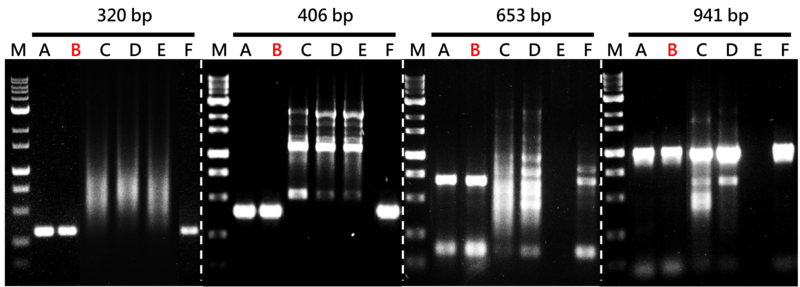
Figure 1. Comparison of non-specific amplifying effects to major suppliers.
All amplifications were performed in accordance with the manufacturer’s instructions to amplify 320 to 941 bp amplicons from human genomic DNA. nanoTaq II provided both higher specificity and yield products with least band shifting compared to other commercial antibody-mediated hot start polymerases. Lane M: 1Kb plus DNA Ladder RTU (DM015-R500), Lane A: nano Taq, Lane B: nano Taq II, Lane C: Thermo DreamTaq, Lane D: Thermo DreamTaq HS, Lane E: Roche KAPA2G HS, Lane F: Invitrogen Platinum HS
*Thermo DreamTaq, Thermo DreamTaq HS and Invitrogen Platinum HS are registered trademarks of Thermo ScientificTM PierceTM. Roche KAPA2G HS is a registered trademark of Merck. The trademark holders are not affiliated with Bio-Helix Co., Ltd. and do not endorse these products.
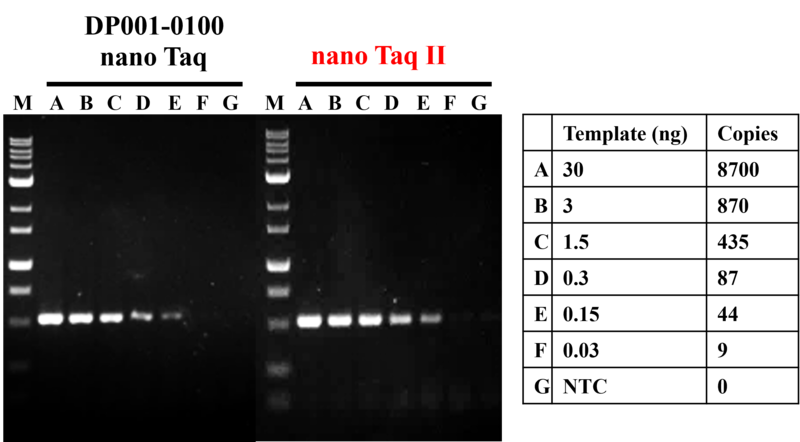
Figure 2. Sensitivity and reliable amplification from low amounts of input DNA.
Amplification of a 500 bp fragment from 30, 3, 1.5, 0.3, 0.15, 0.03, 0 (no template control) ng of human genomic DNA were amplified in 20 μL PCR reactions using nanoTaq II DNA Polymerase.
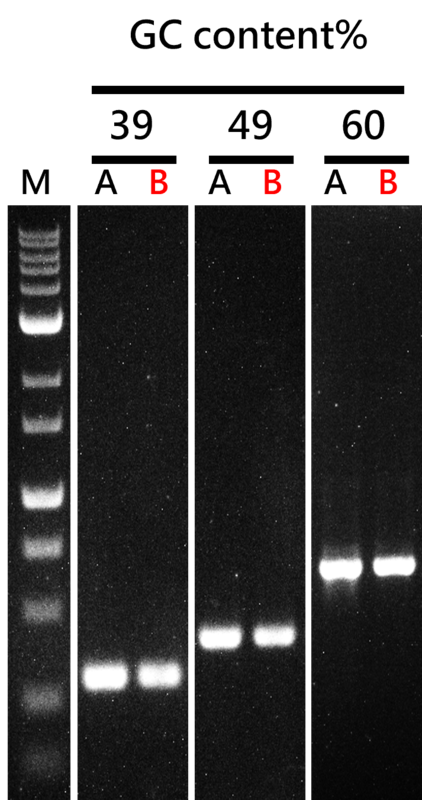
Figure 3. Efficient amplification of DNA sequences with a range of GC content.
A series of DNA fragments of increasing GC content were amplified from human gDNA. nanoTaq Hot-Start DNA Polymerase was used for targets with >50% GC. Lane M: 1Kb plus DNA Ladder RTU (DM015-R500), Lane A: nano Taq (DP001-0100), Lane B: nano Taq II (DP003-0100)
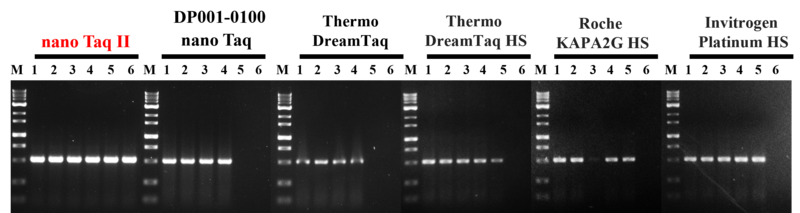
Figure 4. Inhibitor resistance on nanoTaq DNA polymerase
A 280 bp human genomic DNA target was conducted to compare with four leading competing DNA polymerases. All amplifications were performed in accordance with manufacturer’s instructions where the mixtures contain:
Lane 1. no inhibitor control
Lane 2. bile salts with final concentration of 0.5 mg/mL
Lane 3. heparin with final concentration of 0.5 unit/mL
Lane 4. sodium citrate with final concentration of 150 μg/mL
Lane 5. hemin with final concentration of 2 μg/mL
Lane 6. humic acid with final concentration of 8 μg/mL
The results show that nanoTaq has the best tolerance with the humic acid interference, when compared with major suppliers of the hot-start DNA polymerase.
*Thermo DreamTaq, Thermo DreamTaq HS and Invitrogen Platinum HS are registered trademarks of Thermo ScientificTM PierceTM. Roche KAPA2G HS is a registered trademark of Merck. The trademark holders are not affiliated with Bio-Helix Co., Ltd. and do not endorse these products.
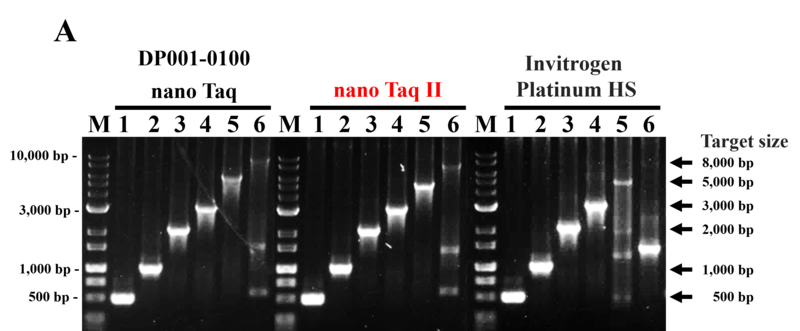
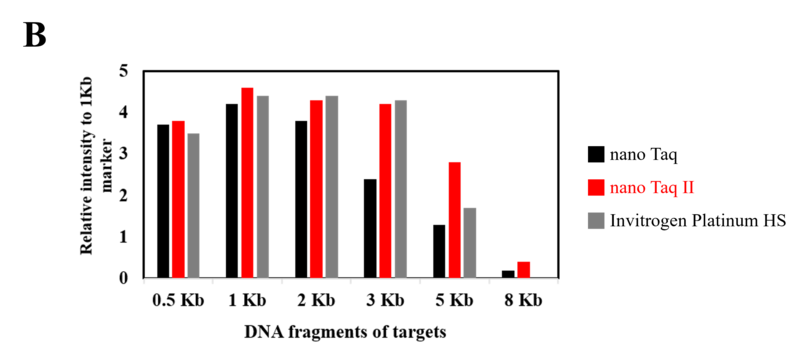
Figure 5. Amplification of long target DNA fragments
It is generally known that Taq DNA polymerase exhibits difficulty amplifying DNA fragment sizes larger than 1 kb. This is probably due to the polymerase’s error-prone amplification process which reduces the efficiency in amplifying longer target sizes. However, we have shown that nanoTaq II is capable of amplifying. Lane M: 1Kb plus DNA Ladder RTU (DM015-R500), Lane 1: 0.5 kb, Lane 2: 1 kb, Lane 3: 2 kb, Lane 4: 3 kb, Lane 5: 5 kb and Lane 6: 8 kb Lambda DNA fragment sizes under the 5-min extension time at 72°C. Therefore, nanoTaq II shows optimal performance in applications with long PCR fragments. Long PCR products can extend the extension time as needed.
*Invitrogen Platinum HS are registered trademarks of Thermo ScientificTM PierceTM. The trademark holders are not affiliated with Bio-Helix Co., Ltd. and do not endorse the product.
► High tolerance aganist various reaction inhibitors
► Reduce nonspecific primer annealing
► Plays in efficient PCR amplification of GC-rich sequences
► Using the same protocol and cycling conditions as conventional Taq DNA polymerases
1. For each 20 μl reaction, assemble the following in a 0.2 ml PCR tube on ice (optional) just before use:
| Volume | Final Conc. | |
| DNA template | - μl | 3 ng |
| Forward primer, 5-10 μM | - μl | 0.1-0.5 μM |
| Reverse primer, 5-10 μM | - μl | 0.1-0.5 μM |
| dNTP Mix (10 mM each dATP, dCTP, dGTP, dTTP) | 0.4 μl | 200 µM |
| 10X PCR buffer | 2 μl | - |
| nanoTaq II Hot-Start DNA Polymerase | 1 μl | - |
| PCR Grade Water | Add to 20 μl | - |
| Total volume | 20 μl | - |
2. Mix gently. If necessary, centrifuge briefly and cap tubes.
3. Place them into the thermocycler and process for 30-35 cycles as follows:
| Initial Denaturation | 3 min at 95°C | |
| Denaturation | 30 sec | 30-35 cycles |
| Annealing | 30 sec at the proper annealing temperature | |
| Extension | 1 min at 72°C | |
| Final extension | 5 min at 72°C |
Note: Optimal conditions for amplification will vary depending on the primers and thermal cycler used. It may be necessary to optimize the system for individual primers, template, and thermal cycler.
Note: Long PCR products can extend the extension time as needed.
* Template:
Purified high quality DNA is needed for a success PCR reaction. The final concentration of cDNA template, please refer to “Reaction Setup”.
* Storage Buffer:
The enzyme is supplied in a storage buffer consisting of 20 mM Tris-HCl (pH 7.5), 100 mM KCl, 0.1 mM EDTA, 1 mM DTT, 50% (v/v) glycerol, and 0.5% Tween 20.
* Unit Definition:
One unit is defined as the amount of enzyme that will catalyze the incorporation of 10 nmol of dNTP into acid- insoluble form in 30 min at 72°C in a reaction containing 20 mM Tris-HCl pH 8.8, 55 mM KCl, 2 mM MgCl2, 0.02 mg/ml BSA, 15 nM primed M13mp18 ssDNA, 0.8 mM dNTPs (0.2 mM each), 1.888 µM 3H-dTTP.


| Name | Download |
|---|---|
| PROTOCOL | Protocol_DP003_20260923.pdf |
| Safety Data Sheet|SDS | SDS_DP003_2026_v1.pdf |